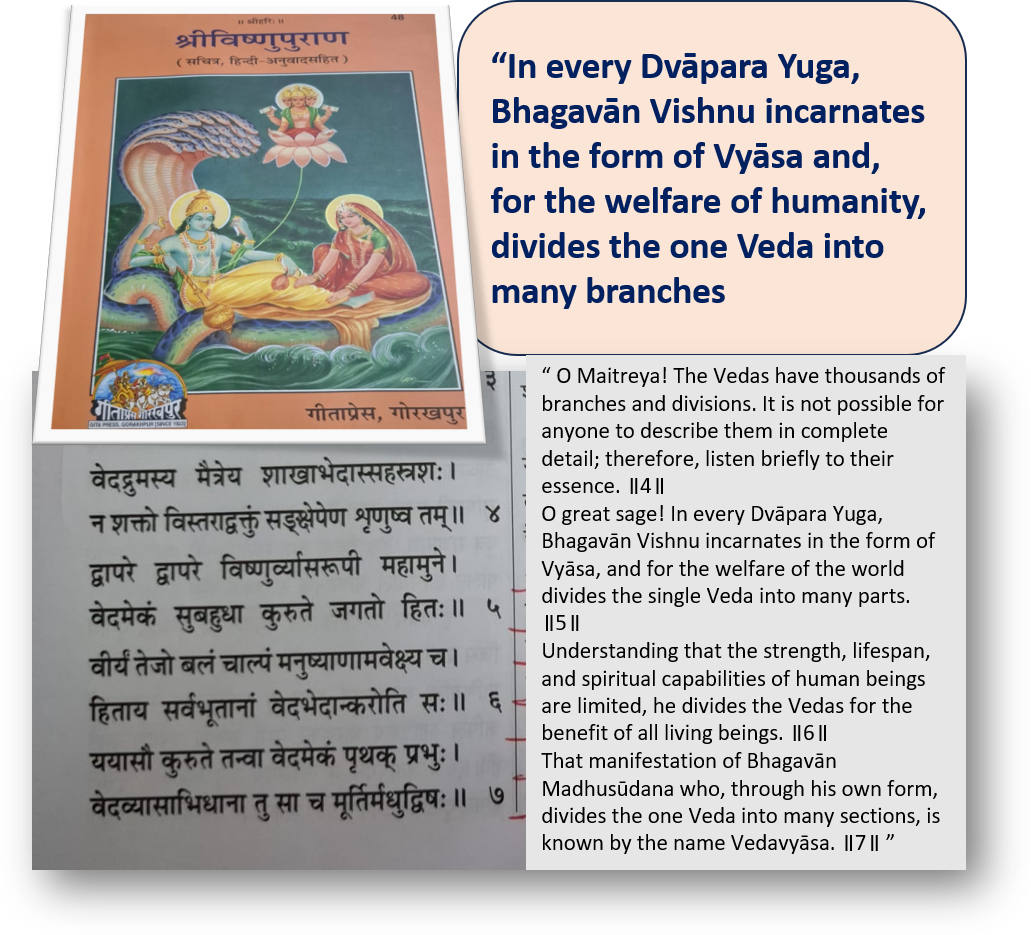
In every Dvapara Yuga, Bhagavan Vishnu incarnates in the form of “Vyasa” for the welfare of Kaliyuga population and divides the Vedas for the benefit of mankind. It is He who composes the Puranas, preserves Sanatana knowledge through the ages, and makes the profound mysteries of Sanatan Dharma doctrines and principles accessible to all humanity. This is extremely important work because Vedic teachings are not accessible to all.
In the Dvapara Yuga of the present Chaturyugi cycle, Shri Hari Vishnu manifested as “Shri Krishna Dwaipayana Vedavyasa.” He divided the Vedas into four parts, composed the eighteen Mahapuranas, and authored the great Itihasa (History) Granth (Scripture) known as the Mahabharata.
The appearance of Bhagavan Vedavyasa was not an ordinary event, but a deeply mysterious and divine occurrence ordained by destiny itself. The Shrimad Devi Bhagavata Mahapurana narrates His birth in extraordinary detail, revealing the sacred mystery surrounding Matsyagandha Satyavati, Maharishi Parashara, and the divine manifestation of Bhagavan Vedavyasa.
Vedavyasa Ji was the great-grandson of Brahmarshi Vashishtha, the grandson of Rishi Shakti, the son of Maharishi Parashara, and the father of Shri Shukadeva Ji. Brahmarshi Vashishtha himself was one of the Manasaputras of Lord Brahma.
Thus, the sacred lineage of Bhagavan Vedavyasa is as follows:
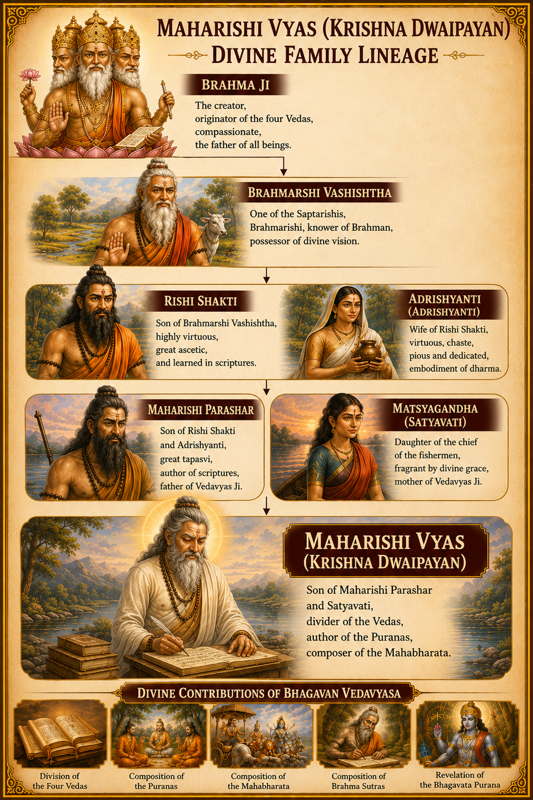
This is the lineage of the present-age Shri Krishna Dwaipayana Vedavyasa. However, before Him, twenty-seven Vyasas had already appeared. Their names are clearly mentioned in the Vishnu Purana (3.3.7–18) and Devi Bhagavata Purana (1.3.24–35).
An important point to understand here is that “Vyasa” is not merely a personal name — it is a divine position. Bhagavan Vishnu Himself incarnates in every Dvapara Yuga as the Vyasa of that age and divides the one Veda into four Vedas and the primordial Purana into eighteen Puranas for the welfare of humanity. Because He performs the division (Vyasa) of the Vedas, He is known as “Vedavyasa.”
The Vishnu Purana states:
“Veeryam tejo balam charyam manushyanam avekshya cha । Hitaya sarvabhutanam vedavyasan karoti sah ॥” (Vishnu Purana 3.3.6)
“At the beginning of every Dvapara Yuga, seeing the decline in the strength, brilliance, memory, and spiritual capacity of human beings, Bhagavan manifests as Vedavyasa for the welfare of all living beings and divides the Vedas.”
Before the appearance of Shri Krishna Dwaipayana Vedavyasa, twenty-seven Vyasas had already manifested in previous Dvapara Yugas. Their names are mentioned in the Vishnu Purana and Devi Bhagavata Purana. They are: Brahma, Prajapati, Shukracharya, Brihaspati, Surya, Yama, Indra, Vashishtha, Sarasvata, Tridhama, Trivrisha, Bharadwaja, Antariksha, Varni, Trayyaruna, Dhananjaya, Ritanjaya, Jaya, Bharadwaja, Gautama, Haryatma, Vajashrava, Somashushmayana Trinabindu, Bhargava Riksha (Valmiki), Shakti, Parashara, Jatukarna, and finally Shri Krishna Dwaipayana Vedavyasa.
In ancient times, there ruled in the kingdom of Chedi a great and righteous king named Uparichara Vasu. He was truthful, devoted to Brahmanas, and possessed extraordinary spiritual brilliance. Pleased by his austerities, Indra had gifted him a celestial crystal aerial chariot through which he traveled across the skies. For this reason, he came to be known as “Uparichara” — the one who moves through the heavens.
His queen was Girika, a supremely devoted and virtuous wife.
One day, after completing her sacred purification bath, Queen Girika awaited the king with the desire for conception. At that very moment, the king received a command from his Pitris to enter the forest and perform a ritual hunt connected with Shraddha rites.
On one side was the sacred duty toward his ancestors, and on the other, the proper time of his queen. The king found himself in a difficult moral dilemma. Finally, giving priority to the command of the Pitris, he departed for the forest.
While wandering in the forest, King Uparichara Vasu repeatedly remembered Queen Girika. In that meditative state, his seed was released. The king realized that this divine seed should not be wasted. He preserved it carefully in a leaf and sent it through a trained hawk toward the queen.
But destiny had already begun weaving a far greater story.
While flying through the sky, another hawk mistook the vessel for flesh and attacked it. During the fierce struggle between the birds, the vessel fell into the waters of the Yamuna.
At that very time, an apsara named Adrika was living in the Yamuna under a curse in the form of a fish. She swallowed the king’s seed.
In truth, Adrika was no ordinary fish. She had once been a apsara who was cursed by a sage after disturbing his meditation. Later, the sage mercifully declared that she would be freed from the curse after giving birth to two children. Months passed, In the tenth month, a fisherman caught that enormous fish in his net. When the fish was cut open, two radiant human infants emerged from within — a boy and a girl.
Everyone was astonished, The children were brought before King Uparichara Vasu. The king kept the boy with him, while the girl was given to the fisherman.
That very girl later became known as Kalika, Matsyodari, Matsyagandha, and eventually Satyavati. Because the smell of fish emanated from her body, people called her “Matsyagandha.”
At that time, who could have known that this fisher-maiden Matsyagandha would one day become the mother of Bhagavan Shri Krishna Dwaipayana Vedavyasa — and through her would unfold the destiny of the Kuru dynasty, Bhishma’s terrible vow, the birth of the Kauravas and Pandavas, and ultimately the great Mahabharata war itself.
As time passed, Matsyagandha grew into a beautiful young woman.
One day, Maharishi Parashara arrived at the banks of the Yamuna during his pilgrimage travels. He was the grandson of Brahmarshi Vashishtha and a great master of austerity and spiritual wisdom. His yogic brilliance and spiritual power were renowned across the three worlds.
He desired to cross the river by boat. At that time, the fisherman was having his meal, so he requested his daughter Matsyagandha to ferry the great sage across the river.
Matsyagandha respectfully seated Maharishi Parashara in the boat and began rowing through the gentle waters of the Yamuna.
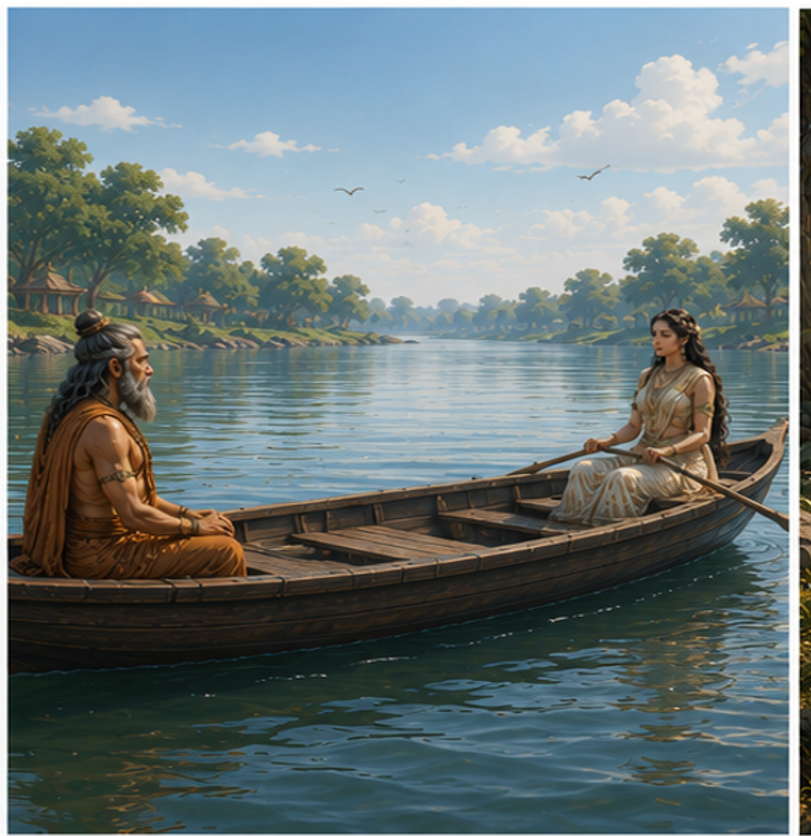
Shrimad Devi Bhagavata Mahapurana describes, that as the boat reached the middle of the river, Maharishi Parashara became deeply aware of the extraordinary beauty of the young maiden and the divine destiny hidden within her.
However, this attraction must not be understood in an ordinary worldly sense. The Devi Bhagavata itself makes it clear that a great yogi like Maharishi Parashara could never be overcome by ordinary lust. This was all divinely ordained.
Maharishi Parashara was a master astrologer and a knower of cosmic destiny. Through his divine insight, he understood that the destined time had arrived for the appearance of Bhagavan Vedavyasa through Matsyagandha- the great sage who would divide the Vedas and compose the Mahabharata.
When Maharishi Parashara gently held Matsyagandha’s hand, she became frightened and spoke with humility and righteousness:
“O revered sage! You are born in the glorious lineage of Bramharishi Vashishtha. Such conduct does not befit a great knower of Brahm like you. I am merely a fisher-maiden carrying the odor of fish. What could possibly attract a great sage like you toward me?”
Her words carried fear, modesty, and deep concern for Dharma, She further said:
“If anyone sees us, I shall be condemned. There is no suffering greater than public dishonor.”
Then Maharishi Parashara used his yogic power to cover the entire region of the Yamuna with dense mist. Darkness spread everywhere as though night itself had descended upon the river. No one could see them.
Still, Satyavati spoke again with folded hands:
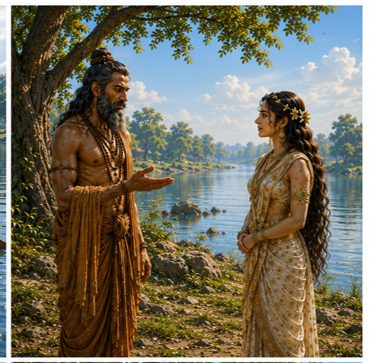
“O Brahman! If a child is born through me, what shall I say to my father? What place will remain for me in society?”
Then Maharishi Parashara granted her several divine boons:
Maharishi Parashara Himself declared:
“Countless celestial apsaras have appeared before me, yet never have I been disturbed. This is all divinely ordained. Surely some great cosmic purpose lies behind it.”
At that very moment, the fish-like odor emanating from Matsyagandha transformed into an extraordinary divine fragrance that spread for miles around.
From that day onward, she became known as “Yojanagandha.”
Dense mist covered the surroundings.In the middle of the waters stood a small sandy island, silent and mysterious, as though concealing within itself some divine secret.
At that sacred moment, Satyavati gave birth to a radiant and extraordinary child.
The child possessed a dark complexion. It seemed as though the depth of the Yamuna and the vastness of the sky themselves had descended into the form of that divine infant.
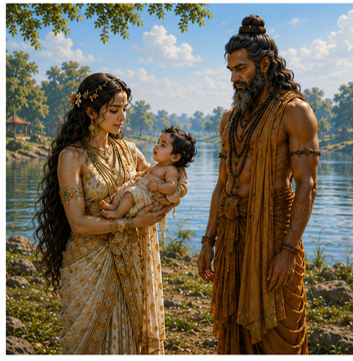
Because He manifested upon an island, He came to be known as “Dwaipayana.” And because of His dark complexion, He was called “Krishna.”
This divine child would later be worshipped throughout Aryavarta as “Bhagavan Shri Krishna Dwaipayana Vedavyasa.”
The Devi Bhagavata Mahapurana describes that He was no ordinary child. Immediately after birth, He grew into a youthful form. His face shone with extraordinary brilliance, and His eyes radiated deep yogic wisdom.
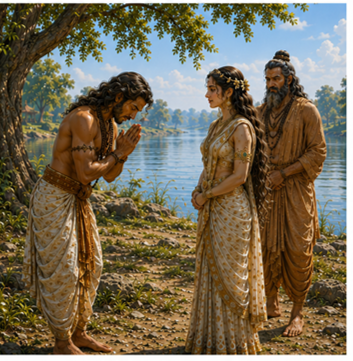
Mother Satyavati stood overwhelmed with wonder and maternal affection as she gazed upon the divine child. Having bowed respectfully at His mother’s feet, the divine child spoke in a calm and gentle voice:
“O Mother! Whenever you feel the need for me, simply remember me, and I shall immediately appear before you.”
Having spoken these words, the divine child departed toward the forests to perform tapasya.
Bhagavan Vedavyasa understood that the fourfold Vedic sacrificial system performed by the Hota, Adhvaryu, Udgata, and Brahma priests served as a means for the purification of the mind. With the intention of expanding and preserving the sacred yajna tradition for humanity, He divided the one Veda into four parts — Rigveda, Yajurveda, Samaveda, and Atharvaveda.
He entrusted the Rigveda to Maharishi Paila, the Samaveda to Maharishi Jaimini, the Yajurveda to Maharishi Vaishampayana, and the Atharvaveda to Maharishi Sumantu, son of Daruna.
The Mahabharata composed by Bhagavan Shri Krishna Dwaipayana Vedavyasa is revered as the “Fifth Veda.”
“Itihasapuranam Panchamam Vedanam Vedam”
(Chandogya Upanishad 7.1.2)
“Itihasapuranam cha Panchamo Veda Uchyate.”
(Shrimad Bhagavatam 1.4.20)
The Mahabharata is simultaneously an epic, a Purana, a philosophical scripture, a Smriti, and a supremely sacred history. It contains the essence and hidden wisdom of the Vedas, Vedangas, and Upanishads.
Within it are contained both timeless and age-bound truths concerning every aspect of existence. It encompasses Dharma Shastra, Artha Shastra, Kama Shastra, Moksha Shastra, political science, ethics, geography, astronomy, environment, food, water, clothing, architecture, education, medicine, roads, vehicles, warfare, diplomacy, treaties, conflict, marriage systems, service, Shraddha, Tarpana, festivals, Samskaras, Varna Dharma, Ashrama Dharma, Arya Dharma, Yajna, charity, tapasya, ordinary duties, duties during calamities, human conduct, Vaishnava, Shaiva, Ganapatya, Shakta and Saura traditions, Nyaya, Vaisheshika, Sankhya, Yoga, Mimamsa, spirituality, the individual body, the cosmos, mantra, tantra, worldly prosperity, and ultimate liberation. (Mahabharata, Adi Parva 1.61–92)
The Mahabharata contains Dharma, Artha, Kama, Moksha, knowledge, science, arts, wisdom, and nearly every aspect of human existence that we see, hear, study, and experience.
Whatever exists in the Mahabharata may also exist elsewhere, but what is not found in the Mahabharata exists nowhere else. In other words, what does the Mahabharata not contain? It contains everything.
“Dharme charthe cha kame cha mokshe cha Bharatarsabha ।
Yad ihasti tad anyatra yan nehasti na kutrachit ॥”
The Upanishadic declaration:
“Sarve Veda Yat Padam Amananti”
(Katha Upanishad 1.2.15)
finds complete fulfillment in the Mahabharata just as it does in the Ramayana and the Puranas. Throughout its beginning, middle, and conclusion, the Mahabharata glorifies Bhagavan Shri Hari in all forms — Saguna and Nirguna, qualified and unqualified, with form and beyond form.
This immense effort of Shri Vedavyasa was undertaken solely to express unparalleled and profound devotion toward the Supreme Lord.
“Mahattvad Bharavattvachcha Mahabharatam Uchyate ।
Niruktamasya Yo Veda Sarvapapaih Pramuchyate ॥”
(Mahabharata, Adi Parva 1.274)
Because of its greatness, depth, gravity, and the extraordinary history of the Bharata dynasty, it is called the Mahabharata. One who truly understands the essence of this scripture becomes freed from all sins.
“Idam Hi Vedaih Samitam Pavitram Api Chottamam ।
Shravyanam Uttamam Chedam Puranam Rishisamstutam ॥”
(Mahabharata, Adi Parva 62.16)
This sacred ancient history, praised by the sages, is as pure and exalted as the Vedas themselves and is supreme among all scriptures worthy of hearing.
“Anagatashcha Mokshashcha Krishna Dwaipayanah Prabhuh ।
Sandarbham Bharatasyasya Kritavan Dharmakamyaya ॥
Shashtim Shatasahasrani Chakara Anyam Sa Samhitam ।
Trimshachchhatasahasrani Devaloke Pratishthitam ॥
Pitrye Panchadasham Jneyam Yakshaloke Chaturdasha ।
Ekam Shatasahasram Tu Manusheshu Prabhashitam ॥
Narado’shravayad Devan Asito Devalah Pitrin ।
Rakshoyakshan Shuko Martyan Vaishampayana Eva Tu ॥”
(Svargarohana Parva 5.53–56)
Bhagavan Krishna Dwaipayana Vedavyasa, who is eternally liberated by nature, composed the Mahabharata out of compassion for Dharma.
Originally, He composed a Mahabharata Samhita consisting of sixty lakh verses. Of these: